Independent guide
Settle Prep is not affiliated with or endorsed by Trinity College London. We describe the published format so you can practise. Which test and level your application needs is a question for GOV.UK or a regulated adviser.
Status on 31 October 2026
Source: Trinity: B2 English test (GESE Grade 7), read 31 October 2026.
The B2 test tracker shows the status of every B2 test, and logs each change.
The exam at a glance
15 minutes with one examiner, in three parts. The examiner joins by video, and you sit at a Trinity centre. Bring your ID and your notes on your topic. There is no Topic Form at this level.
-
Topic phase about 5 minutes
You introduce a topic you prepared, and lead the talk about it. The examiner asks questions and may interrupt.
-
Interactive phase about 4 minutes
The examiner describes a situation. You ask questions to find out more, and you keep the conversation going.
-
Conversation phase about 5 minutes
A conversation on two subjects that the examiner picks from a list of six.
How Grade 7 differs from Grade 5
- It's longer: 15 minutes, against 10 for Grade 5.
- There's a new middle part, the Interactive phase.
- You lead the topic. At Grade 5 the examiner picks points from your form. At Grade 7 you introduce the topic and drive the discussion, and you deal with questions and interruptions.
- There's no Topic Form. Trinity encourages short notes, a mind map or a diagram to share with the examiner. These notes aren't marked.
- The conversation subjects are different.
- The language moves up. Trinity's list includes the second conditional, the passive, “used to”, relative clauses, and language for advice, suggestions, possibility, and agreeing or disagreeing.
Part 1: the Topic phase (about 5 minutes)
You choose and prepare a topic you know and care about. Trinity's guidance says:
- Don't take it from the conversation subjects.
- Don't write a script. A memorised speech counts against you.
- Pick something that lets you use Grade 7 language. Its candidate guide says a topic such as “my family” may keep your language too simple.
In the exam, you introduce the topic and talk in longer turns. Bring the examiner in: ask what they think, and react to their questions and interruptions. Explain and give examples when asked.
Part 2: the Interactive phase (about 4 minutes)
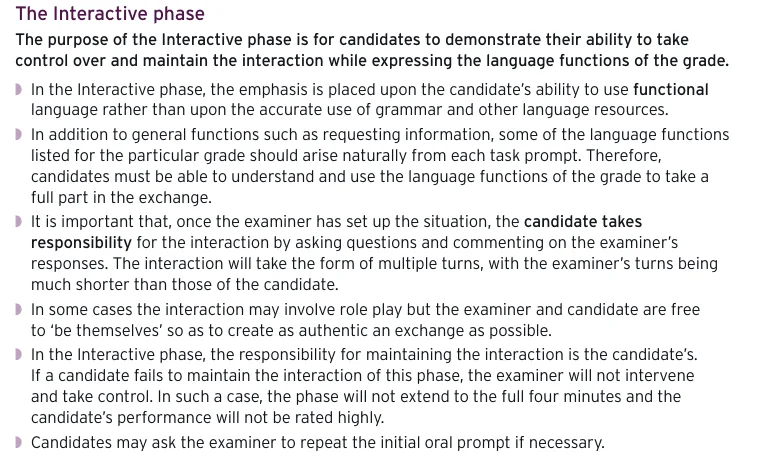
This is the part many people find new. It works like this:
- The examiner tells you about a short situation: something that happened, a problem or a plan. Trinity calls this a prompt.
- Your job is to find out more by asking questions, and to comment on the answers. Give advice, suggest something, agree or disagree.
- You keep the conversation going. Trinity's guidance says that once the situation is set up, this is your job. If you stop, the examiner does not take over, and the phase ends early.
- You may ask the examiner to repeat the prompt.
How to practise:
- Practise questions: “What happened next?”, “Why do you think…?”, “Have you thought about…?”
- Practise ways to keep talking: “So what you're saying is…”, “If I were you, I'd…”, “That might be because…”
- Practise with a partner who answers briefly and lets you lead.
Part 3: the Conversation phase (about 5 minutes)
The examiner chooses two of these six subjects:
- Education
- National customs
- Village and city life
- National and local produce and products
- Early memories
- Pollution and recycling
You and the examiner share this conversation. Give opinions and reasons, not only facts. Ask questions too.
The language the examiner listens for
From Trinity's Grade 7 list, in plain terms:
- Advice, and the good and bad sides of something: “You'd better…”, “The advantage is…”.
- Suggestions: “Why don't we…?”, “How about…?”
- Past habits: “I used to…”.
- Possibility: “It might be…”, “I'm not sure, but…”.
- Asking for more detail: “What do you mean by…?”, “Could you tell me more about…?”
- Agreeing and disagreeing politely.
- Grammar: the second conditional, the simple passive, relative clauses, and linking words such as “because of” and “due to”.
- Listening and reacting: “Really?”, “Oh dear!”, short fillers like “well…”, and your voice going up or down.
How it is marked
The examiner gives a letter for each of the three parts:
- A = Distinction
- B = Merit
- C = Pass
- D = below a pass
Trinity's rules say that two D grades mean the exam is not passed overall, whatever the third letter is. If you get a C or D in a part, the report names one thing to work on.
Practising now
Trinity has published the format, a candidate guide and the subject list, so you can start before bookings open.
Our free speaking check has a B2 practice mode in the style of this format: a topic you lead, a short interactive task, and one conversation subject. It takes about 4 minutes and gives a practice estimate, not an official result.
Common questions
Can I book GESE Grade 7 now?
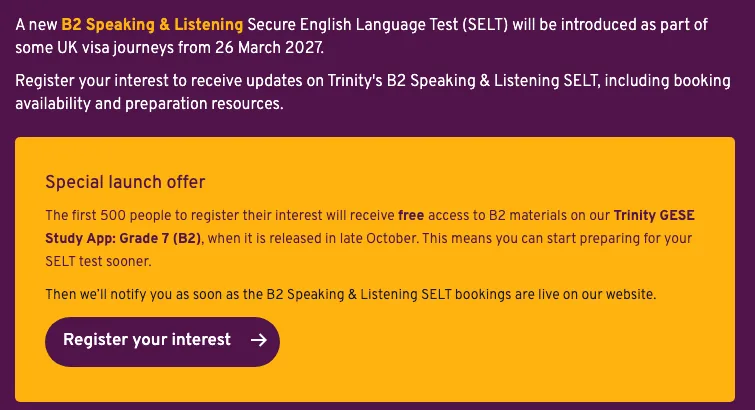
Not on 31 October 2026. Trinity offered only a register-interest form, and Grade 7 was not in its booking system.
How much is GESE Grade 7?
Trinity had not published a price on 31 October 2026. Its B1 GESE exams cost £160.
Is there a Topic Form for Grade 7?
No. At this level, Trinity encourages short notes, a mind map or a diagram to share with the examiner. They aren't marked.
What is the interactive phase?
About 4 minutes in which the examiner describes a situation. You ask questions and comment to find out more. You keep the conversation going: the examiner won't lead it for you.
What are the Grade 7 conversation subjects?
The examiner picks two of these:
- Education
- National customs
- Village and city life
- National and local produce and products
- Early memories
- Pollution and recycling
Is GESE Grade 7 the B2 test for ILR?
The provider says it will be used for ILR (settlement) applications made on or after 26 March 2027. On 31 October 2026 it was not yet on the GOV.UK approved list. For your own application, check GOV.UK or a regulated adviser.
Is the “Trinity B2 collaborative task” the same thing?
No. A collaborative task is part of Trinity's ISE II, a four-skill B2 test. GESE Grade 7 has an interactive phase instead.
Sources
We read each of these on the date shown and last checked this page on 31 October 2026.
- Trinity: B2 English test (GESE Grade 7) read 31 October 2026
- Trinity: GESE Grade 7 SELT B2, Guide and Preparation for Candidates (PDF, online edition September 2026) read 31 October 2026
- Trinity: GESE Exam Information, Intermediate stage and Grade 7 (PDF) read 31 October 2026
- Trinity SELT booking site (exam list) read 31 October 2026
- Trinity: SELT FAQs read 31 October 2026
- Trinity: B2 English test (ISE II) read 31 October 2026
- GOV.UK: List of approved secure English language tests taken in the UK (ODS) read 31 October 2026
Update log
- First published.